
IT outsourcing has become an increasingly popular strategy for businesses worldwide in order to access specialized skills, cost-effectiveness, and scalability. When considering outsourcing options, Germany emerges as a compelling destination with its robust IT industry and reputation for excellence in technology and innovation. In this article, we explore the alternative options that IT outsourcing to Germany offers.
Outsourcing in Europe is the preferred option for the vast majority of companies in Germany. In 2019, 77% of German enterprises nearshored their software development in Europe. Only 18% outsourced to Asia, and a mere 4% and 1% had chosen Africa and South America, respectively.
Explanation of the Traditional Model of IT Outsourcing in Germany
The traditional model of IT outsourcing in Germany is a full outsourcing model, where the entire IT function is outsourced to a third-party provider. This model was popular in the early days of IT outsourcing, when businesses were looking to reduce costs and improve efficiency.
IT Services Overview:
- Application Development and Maintenance. Application development and maintenance is the process of creating, updating, and supporting software applications.
- Infrastructure Management. Infrastructure management is the process of managing the hardware and software that supports a business’s IT systems.
- Security and Compliance. Security and compliance is the process of ensuring that a business’s IT systems are secure and compliant with applicable regulations.
- Helpdesk and Support. Helpdesk and support is the process of providing technical support to users of a business’s IT systems.
Types of IT Outsourcing
Germany IT outsourcing is the practice of hiring a third-party provider to manage all or part of a company’s IT infrastructure or operations. There are many different types of IT outsourcing, but they can be broadly categorized into three main types:
- Offshoring. This is the most common type of IT outsourcing, and it involves outsourcing IT services to a third-party provider in another country. Offshoring can offer significant cost savings, but it can also be more challenging to manage due to the time zone differences and cultural differences.
- Nearshoring. This type of IT outsourcing involves outsourcing IT services to a third-party provider in a neighboring country. Nearshoring offers many of the same benefits as offshoring, but it can be easier to manage due to the shorter time zone differences and cultural similarities.
- Onshoring. This type of IT outsourcing involves outsourcing IT services to a third-party provider in the same country as the outsourcing company. Onshoring can offer some of the benefits of outsourcing, such as access to specialized skills, but it may not offer as much cost savings as offshoring or nearshoring.
Which are the Best Examples of Outsourcing?
Outsourcing can be a valuable tool for businesses that are looking to save money, improve efficiency, and gain access to expertise. However, it is important to carefully consider the benefits and challenges of outsourcing before making a decision. As for the best example of outsourcing, it is difficult to say definitively which one is the best.
However, Some of the most Well-Known Examples Include:
- Apple. Apple outsources the manufacturing of its products to third-party providers, such as Foxconn. This helps Apple save money on labor costs and improve the efficiency of its manufacturing operations.
- Google. Google outsources its customer service to third-party providers, such as Convergys. This helps Google save money on labor costs and improve the efficiency of its customer service operations.
- Microsoft. Microsoft outsources its IT services to third-party providers, such as Tata Consultancy Services. This helps Microsoft save money on labor costs and gain access to expertise that may not be available in-house.
These are just a few examples of outsourcing. There are many other businesses that outsource various tasks and services. The best example of outsourcing will vary depending on the specific needs of the business.
The Main Benefits
The best type of IT outsourcing for a business will depend on its specific needs and requirements. Businesses should carefully consider their options before choosing an IT outsourcing model.
Here are Some of the Benefits of IT Outsourcing:
- Cost Savings. Outsourcing can help businesses save money on labor costs, especially for tasks that are not core to their business.
- Access to Expertise. Outsourcing providers can offer access to a pool of specialized skills that may not be available in-house.
- Focus on Core Competencies. Outsourcing can allow businesses to focus on their core competencies and outsource non-core activities.
- Improved Efficiency. Outsourcing can help businesses improve the efficiency of their IT operations by leveraging the expertise of the outsourcing provider.
- Reduced Risk. Outsourcing can help businesses reduce their risk of security breaches and compliance violations by leveraging the expertise of the outsourcing provider.
Average Spend Per Employee by Segment
Average spend per employee is a key performance indicator (KPI) that measures the average investment a company makes in each of its employees. It provides valuable insights into the efficiency of various industries, the level of automation, employee compensation, and overall business competitiveness.
Additionally, this metric aids policymakers and analysts in understanding labor market dynamics, productivity trends, and economic disparities across sectors.
Germany, renowned for its robust industrial base and diverse economy, boasts a range of sectors contributing significantly to its GDP. Some of the prominent industries in the country include manufacturing, automotive, technology, healthcare, finance, and services. Each segment holds a unique place in the nation’s economy, and analyzing their average spend per employee helps discern their relative contributions.
| Segment | Average Spend per Employee |
| IT Outsourcing | €533.90 |
| Administration Outsourcing | €369.20 |
| Application Outsourcing | €452.30 |
| Web Hosting | €238.90 |
| Other IT Outsourcing | €191.70 |
As you can see, the average spend per employee varies depending on the segment. IT Outsourcing is the most expensive segment, followed by Administration Outsourcing and Application Outsourcing. Web Hosting and Other IT Outsourcing are the least expensive segments (Source: Statista).
Overview of Major IT Hubs in Germany
Germany, a powerhouse in the European Union, is home to several major IT hubs that drive innovation, research, and technological advancements. These IT clusters attract talent, investment, and global partnerships, contributing significantly to the country’s digital economy.
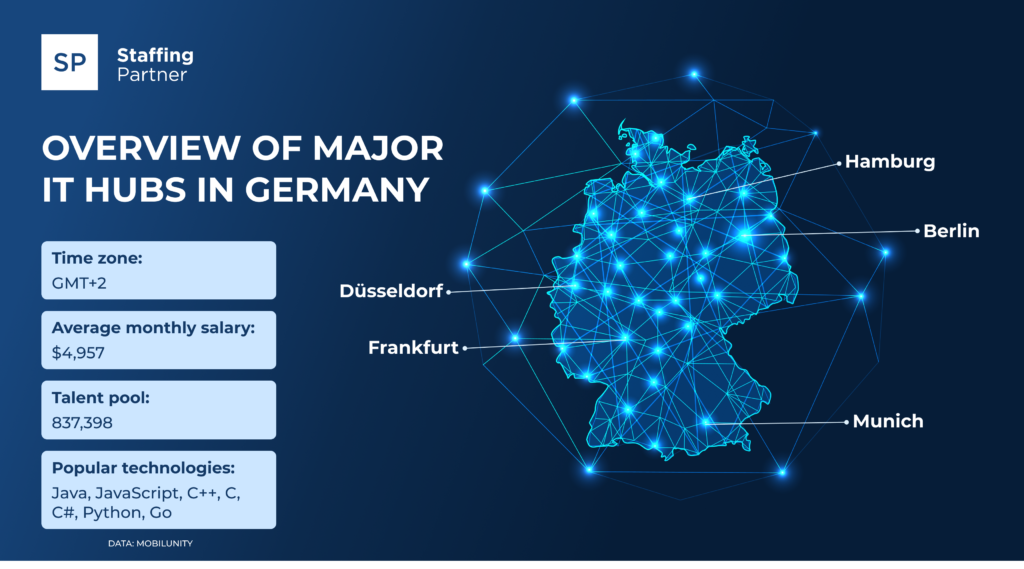
Let’s Take a Look at an Overview of Some of the Major IT Hubs in Germany:
- Munich. Munich is the largest IT hub in Germany, and is home to many of the country’s top tech companies, such as SAP, Siemens, and BMW. The city is also a major center for research and development, and is home to several universities with strong STEM programs.
- Berlin. Berlin is another major IT hub in Germany, and is known for its thriving startup scene. The city is also home to a number of government agencies and research institutions, which provide a strong foundation for the tech industry.
- Frankfurt. Frankfurt is a major financial hub in Germany, and is also home to a number of IT companies. The city is well-connected to the rest of Europe, and is a major center for data center operations.
- Hamburg. Hamburg is a major port city in Germany, and is home to a number of IT companies that specialize in maritime technology. The city is also a major center for logistics, and is home to a number of IT companies.
- Düsseldorf. Düsseldorf is a major business center in Germany, and is home to a number of IT companies. The city is well-connected to the rest of Europe, and is a major center for financial technology.
Cost Considerations and Competitive Pricing Models
Cost considerations and competitive pricing models are two important factors that businesses need to take into account when setting prices for IT outsourcing services in Germany.
Cost Considerations
The cost of IT outsourcing services in Germany can vary depending on a number of factors, including the specific services that are being outsourced, the level of expertise required for the services, the location of the outsourcing company, and the size of the outsourcing company.
Some of the most common costs associated with IT outsourcing services in Germany include:
- Staffing Costs. The cost of hiring and managing IT staff in Germany.
- Overhead Costs. The cost of office space, equipment, and other overhead expenses.
- Travel and Expenses. The cost of travel and expenses for employees who need to travel to Germany for work.
- Training Costs. The cost of training employees on new software or technologies.
- Consulting Fees. The cost of hiring consultants to help with IT projects.
Competitive Pricing Models
There are a number of different competitive pricing models that businesses can use when pricing IT outsourcing services in Germany.
Some of the most common models include:
- Cost-Plus Pricing. This is a pricing model in which the price is set to cover the cost of the services plus a markup to cover the cost of profit.
- Competitive Pricing. This is a pricing model in which the price is set to match or beat the prices of competitors.
- Value-Based Pricing. This is a pricing model in which the price is set based on the perceived value of the services to the customer.
The best competitive pricing model for a particular business will depend on a number of factors, including the type of services being outsourced, the target market, and the competitive landscape.
Outsourcing to Germany with StaffingPartner
StaffingPartner is a global recruitment agency that constantly monitors all current trends in hiring the best IT candidates. That’s why one of our regular hiring practices is team leasing for our client needs. We conduct an in-depth analysis of the market of specialists, using locations in all the countries of Europe and America, as well as successfully recruit a team or a whole staff from scratch.
StaffingPartner also Offers a Variety of Services, including:
- Global IT Recruitment. Get access to a global tech talent resource to save costs, scale your development team fast, or achieve round-the-clock productivity.
- Executive Search. IT executive search, the most demanding type of recruitment in IT, requires skills only well-trained recruiters can provide.
- Recruitment Process Outsourcing. Save costs and time by delegating your recruitment process to a scalable team of experienced IT recruiters with access to a 300K candidate database.
- Recruitment Consulting. Whether you are starting to hire in a new location or looking for a way to increase recruitment efficiency, we will teach you how to do that.
- Tech Assessment. Scale your technical interview capabilities in order to technically assess as many candidates as you need during a high season.
To Sum Up
Germany is a popular destination for IT outsourcing, but there are other countries that offer similar benefits at a lower cost. Poland, Bulgaria, Romania, and Portugal are all excellent alternatives to Germany for IT outsourcing. These countries have large and skilled IT workforces, convenient time zones, and a strong commitment to quality.
By partnering with a professional staffing agency, organizations can tap into specialized expertise, advanced technology, and streamlined processes to attract and secure top talent. StaffingPartner is a global recruitment agency that constantly monitors the current trends in hiring the best IT candidates in various locations. Try working with our professionals!

Want to know more about outsourcing to Bulgaria? Read this Article: IT Outsourcing to Bulgaria — Top-Notch Tech Talent
FAQ
The most commonly outsourced IT service is IT support. This includes tasks such as help desk support, system administration, and network management. Outsourcing IT support can free up internal IT resources to focus on more strategic initiatives, and it can also help to reduce costs.
Nearshoring is a business strategy in which a company outsources its services or projects to a third-party provider located in a nearby country or region, typically one with geographical proximity and similar time zones. This approach is often used in the context of IT services, software development, and other knowledge-intensive tasks. Nearshoring is considered an alternative option to traditional offshoring, where services are outsourced to a more distant country, often on a different continent.
Language and cultural compatibility are essential factors in IT outsourcing, especially when outsourcing to companies or teams located in different countries or regions. These aspects play a significant role in the success of the outsourcing relationship and can impact communication, collaboration, and overall project outcomes.
Latest articles

The modern competitive job market causes technical interviews to become a mandatory process of gauging the candidates who apply to work in areas such as software development, engineering, data science,…

During the past decade Brazil IT outsourcing has established itself as a leading center throughout Latin America. The rising number of IT professionals in Brazil together with its expanding technology…

Modern organizations operating in a quick-moving business environment need to allocate their resources to employee development as well as innovation and operational procedures. HiPo employees represent a vital group because…